How Belonging Finds You
On being the wrong fan in the right moment — and what sports actually does for people who need it to mean something.


I am not an average American sports fan.
Growing up four stops away from Manhattan on an Metro North line, there were some default options for sports teams, but my family was a house divided for baseball. In one corner, my dad and sister are Yankees fans. My mom and brother, Red Sox. I told people I was a Mets fan mostly to keep the household from tipping. It worked, in the sense that no one took me seriously and I never had to care.
This was probably inevitable. I was not, to put it generously, a natural athlete. My dad and aunts rode competitively growing up. I was the first grandchild, which meant I was placed on a horse almost immediately, as if athletic ability were something you could install early enough. I won light blue ribbons (last place) and had enough falls to eventually make my peace with the ground.
From there, the trajectory was consistent. I hate running, which eliminated soccer. I grew into my body early, a 5'8" 13 year old. Tall but not disciplined enough for the volleyball team which had not lost a game, set, or match in decades — a fact I respected enormously from a distance. Not aggressive enough for basketball in a predominantly white town where aggression read differently depending on who had it. I kept up with field hockey through JV, and attempted a club version in college until a scrimmage against a few Danish male exchange students made me permanently reconsider my commitment to the sport.
Softball I was actually good at, until I wasn't — I chose a spring break Holy Week visit to the Vatican over conditioning and lost my shot at varsity, and decided that was probably fine.
I learned to ski, as most privileged children do. I did not keep it up when it became clear the sport required both disposable income and vacation days, neither of which I had in abundance.
My siblings were the athletes, both put on skates at an early age while my dad coached. I ate snack bar food and played arcade games while they practiced. Somehow I absorbed the sport by accident: the rhythm of it, the particular violence, the way a game can turn in thirty seconds. I became a fan the way you become fluent in a language you never formally studied: through proximity, repetition, and having nowhere else to be.
Which is probably how I ended up at a liberal arts college in Baltimore with no football team, something I did not realize at the time was a life-altering decision for water cooler talks. American football is apparently the connective tissue of adult conversation and I arrived in the real world with a gap where that should have been.
The Ravens filled part of it, briefly. I attended the Super Bowl parade, and was happy in the way you're happy when something good happens to a city you're borrowing. But the shine came off fast when Ray Rice's name became shorthand for something much darker. I stopped feeling borrowed happiness and sat with the specific discomfort of loving a thing that keeps showing you who it really is.
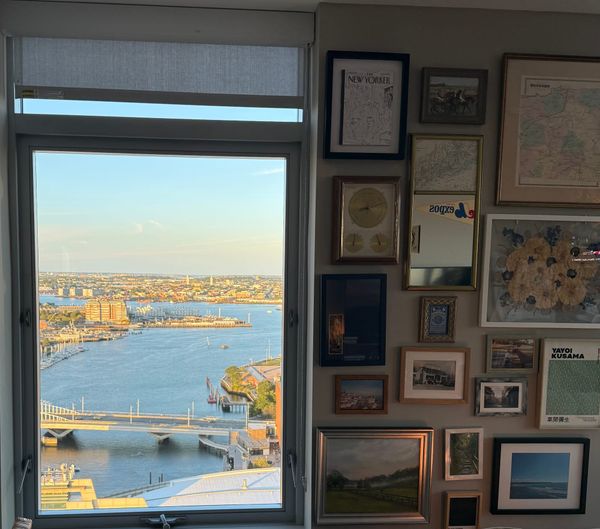
I followed the Nats for years in DC because they were bad and tickets were cheap, and the park sat along the waterfront which felt like enough. I have never cared about basketball. Now living above TD Garden, I am being asked about Jaylen Brown more than I ever anticipated.
What I actually care about, if pressed: the Bruins - assimilated by osmosis, and sheer exposure. The World Cup, but only Argentina, a country I moved to in my formative years that claimed something in me it hasn't given back. And horse racing, because my family bred thoroughbreds, and we once had a horse in the Kentucky Derby the year of American Pharaoh.
Ours ran dead last.
That, more than anything, is probably my relationship to American sporting glory in a sentence: present for it, adjacent to it, entirely unclaimed by it.
Here is what I have learned from being a reluctant, accidental, geographically inconsistent sports fan: the sport is never really about the sport.
It's about where your loyalties belong - and what version of American ambition you root for. About what a city needs to believe about itself in a particular moment, and what it is willing to overlook to get there.
Sports become the arena where things we can't say out loud get said anyway. History shows up in a body, a gesture, in determined amount of minutes of controlled chaos watched by thousands of people simultaneously.
In 1968, Tommie Smith and John Carlos raised their fists on the Olympic medal podium in Mexico City, and the whole world understood what they meant. In the same city in 1986, Diego Maradona punched the ball into the net with his hand, la mano de Dios, and an entire nation understood that too. Not just as cheating, not just as genius, but as something specifically Argentine. A Global South country finding a way to beat back the English Empire by any means necessary, four years after the Falklands War (Guerra de Malvinas). The ref missed it, but history did not.
The game is the container for moments like these. What people bring to it — the passion, the pride, the grief,— is what fills it.
America has always been better at building the container than understanding what goes inside. We invented the global export of athletic aspiration. The mythology of the comeback, underdog, and champion. We sold the world the aesthetics of winning so thoroughly that our logos ended up on the backs of people cheering against us. And yet, as a country, we have remained oddly immune to what sports actually does for people who need it to mean something.
Because we are so used to winning we have forgotten what it feels like to need it.
Argentina needed it in the 2022 World Cup. I was lucky enough to be in Buenos Aires for the group stage games, as Messi and the rest of the country were desperately reaching for something they wasn't sure they was going to get. The Saudi Arabia opener could be considered one of the greatest upsets in FIFA history, and the city went quiet in ways I had never felt before. But their anthem that year, Muchachos, ahora nos volvimos a ilusionar, a cover of an old ska song about getting drunk, became something closer to a national prayer by the end.
I stayed and was lucky enough to watch the must-win match against Mexico at a packed sports bar called Locos por el Futbol, which felt about right. Look, I have not done many serious drugs in my life. I want to be precise about this because I need you to understand the comparison I am about to make.
When Messi scored, my soul left my body.
There is no other way to describe it. The goal went in and the entire bar, the entire country, released the compressed weight of a nation all at once. Primordial is the right word. It was the most cathartic thing I have ever experienced.
This summer, the World Cup has arrived in the U.S. and America is not okay. ICE raids at stadiums. Corruption threaded through the FIFA bidding process and a government that welcomed it with open arms. A 250th birthday party for a country that is simultaneously the world's dream and its own worst argument against itself. We are hosting the world's most watched sporting event in a country that is, at this particular moment, actively making it harder for the world to be here.
And yet the world has showed up anyway. Because that's what the World Cup does: it finds cities and fills them with people who love a place enough to travel thousands of miles to sit in 90+ degree heat and watch eleven people run after a ball, hydration breaks and all.
I was listening to a podcast (ok - saw a clip of a podcast from Tiktok and then went to listen) from The Athletic in which the writer Daniel Alarcón reflected on this moment I think really well:
"One other thing that I think Americans don't get because we don't have a diaspora, diasporas come to us. National teams for diasporic peoples are so important. Because they are the simplest way to express your love for a country even if that love can be very complicated, even if your parents left because they had to. You still love that place, and the national team for 90 minutes allows you to simplify that. You throw on the jersey, you forget about the politics, you forget about your crazy family, you forget the reasons you emigrated and you just express this very simple love for a place that you come from."
John Green — yes that John Green — was also on and responded with a line from Ulysses where someone asks what a nation is and the answer comes back: a nation is the same people in the same place, or in other places.
America is 250 years old this summer. It is, depending on who you ask, and which parts of history you're willing to look at, either an extraordinary experiment in self-governance or a long con dressed up in constitutional language. Almost certainly both. And it is hosting a World Cup.
And people are coming from everywhere — from the countries we've sanctioned, countries we've bombed, countries whose citizens we are currently detaining at the border — and they are filling stadiums where they sing and cry and put on jerseys to simplify the most complicated love they know.
I don't know how to hold the ICE raids, the treatment of the Iranian team, this administration's corruption and those stadiums full of singing fans in the same hand. I don't know how to feel something uncomplicated in a moment that isn't, or whether trying to is its own kind of moral failure — or whether refusing to is just another way of letting the worst of it win.
I've been watching anyway, feeling things I can't fully defend or dismiss. Thinking about the horse that ran dead last, the bar in Buenos Aires, and all the ways belonging sneaks up on you sideways.
For 90 minutes at a time, it'll have to be enough.
As I finish this up Argentina is playing the Cinderella story of this World Cup, Cabo Verde (and Messi just scored - truly the greatest of all time).
Still trying to write - thanks for reading.